19 BELL LANE
008-061
DAR# 88
Basic text is from the DAR History of Hollis Homes, edited by Deborah E. Lovejoy 1953 with accompanying map (Cudworth). Codes used are initials of editors from this book and from 1999-2000 update editors. See bibliography for full information.
This farm on a side road west of the Dow Road was formerly land owned by Enoch and Josiah Hunt. They were in West Dunstable in 1739. The first house on the place was on the west part of the farm near the present Wendell Lovejoy buildings. [Lovejoy house was on the east side of Pepperell Road - now since the road was changed, 16 Spaulding Lane. 2000ese] Reuben Dow, who was living at the former Barton Homestead near the present Nichols Estate on Love Lane, gained possession of the Hunt land in 1762 and 1764. Reuben Dow was from Salem, NH. He was captain of the Minute Men and also of the Hollis Company at Bunker Hill. He was a friend of Col. Prescott and so the Hollis Company joined a Massachusetts regiment. Captain Dow was wounded at Bunker Hill. Two of his sons were privates in the Revolution. It was at his house (probably south of the present site) that the company stopped April 19, 1775 and were given rations for their journey.
Reuben’s son Stephen who married Abigail Jewett, a daughter of Jacob Jewett, became possessor of the farm upon the death of his father. He in turn gave it to his son Jeremiah. Jeremiah put a second story on the house built at present site and made other additions. He and Sarah Eastman Dow had but one child, a daughter Sarah who married John Bell. She died before her parents and the farm was given by Jeremiah to his grandson, Charles D. Bell, with some restrictions. It soon passed to Charles D. Bell’s son, Charles Jeremiah - always known as Jerry Bell after the death of his father. Jerry Bell, who married Emma Howe of Hollis, made additions to the buildings and improved the farm in many ways. The house was burned in 1931, but was rebuilt at once. At Jerry Bell’s death (1949) the farm came into the possession of his three sons, one of whom, Charles E. Bell still resides there. The farm is cultivated by Hartwell Bell, a son of Charles, who also resides there. Woodbury Dow Bell, another son, after his marriage remodeled the apple house and used it as a dwelling house. The eighth generation of Reuben Dow’s descendants, now named Bell, are growing up on his old farm (1952). It’s the ninth.
The family tradition is that the barrel was rolled out of the cellar bulkhead in 1775 on the site of the present house. Perhaps Reuben Dow had built a second house there. The first house was across the road, south of the later house. This old first house was still standing in 1890. Ethel Goodwin remembers that John Lund with his family were living there then and there was no one in the other house.
Jeremiah Dow died in 1875. His grandson, Charles D. Bell, who married Anna Parker, lived here for a time and then bought a house in the village. He was lost at sea in 1884. By (1999) the time Jerry Bell (b. 1867)was old enough to take charge of the farm, it was in a run-down condition. He gradually brought it back into one of the best farms in town. For some years (perhaps around 1900) he had large greenhouses across the road from the house. Probably he tore down the old house at that time. Later Jerry Bell built an extension on his house almost like another house where the hired men lived.
 |
 |
 |
The whole set of buildings burned in 1931. Will Gates built a new barn first. As soon as possible a new house was built and the Bell families were back in their own home by Christmas 1933.
All three sons have lived on the second floor of their father’s house: Charles E. who married Doris Hartwell, Harry H. who married Helen Worcester, and Woodbury Dow who married Rita Mollet.
Note: Frank Burge says, “Stephen Dow married Abigail Jewett, daughter of Jacob Jewett, in 1784 and settled at the old Dow Homestead. The house then stood a little south of present one.”
In 1957 this farm with its buildings was sold to Fred Allen.
[The following was contributed by Martha Bell Rogers 2000: From The Union, Manchester, NH 5-10 -1941: Article” Titled Farmers of Four N.E., States Turn Hollis Sale of Bell Ayrshires Into Field Day and Show Jerry Bell, Owner, Watches Silently as Auction Goes On Ill Health Brings Retirement of Outstanding NH Farmer 75 Head of Cattle, Farm Tools Sold” The sale took place 10 years after a disastrous fire from which he had recovered and rebuilt. Excerpts from full page article: “The herd of 75 registered purebred Ayrshire cattle from a one time 120 head herd were sold at auction with farm equipment (manure spreaders…) $175. was paid for a fine milker; the bull for $160…. The Bell Farm had 211 acres of homeland and 260 acres of auxiliary land …. Jerry Bell ran a retail milk route for 28 years in Nashua … and employed 6 men …and for 26 years shipped apples to Liverpool, England and …bought local fruit for the American Fruit Growers Association. One year…a total of 200,000 bushels…. Jerry Bell was director of the state New England and National Ayrshire Breeders Assoc. He was President of the Granite State Dairymen’s Assoc.., an active member of the Farm Bureau and Hollis Selectman and School Board Member.” 1999]
 |
 |
 |
|
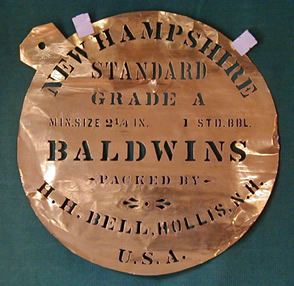
Stencil - Barrel Top
|
32 Bell Lane
|
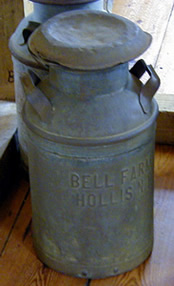
Milk Can
|
Woodbury Bell kept his share of the farm with the house in the orchard. This house, Mrs. Doris Bell says, was originally a cold storage house but was made into a dwelling house when the main house burned. In 1958 Mr. Bell maintains a poultry plant here. Ralph Anderson occupies the house.
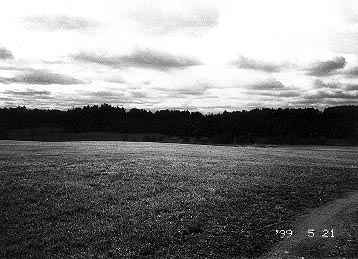
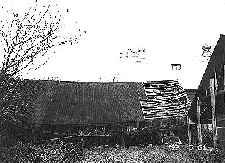
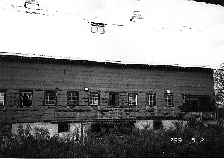
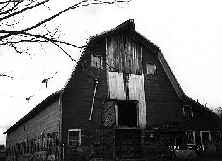
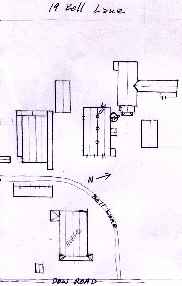
[In 1999 Martha Bell Rogers, granddaughter of Charles J. (Jerry) and Emma Bell, helped map this large farm. In 1999 Kevin Curran of Blood Road owns it. The house is dilapidated and unoccupied as are the farm buildings. They are unused except for storage by the neighboring farmer. Three barns remain, one with a silo. These buildings date from the 1930s. No knowledge was apparent of the location of Reuben Dow’s 1775 bulkhead said to have been on the location of the house. According to MBR a farm stand was active in Jerry Bell’s time and stood directly in front of the house on edge of Dow Road; then the relationship of house to road was changed as the road was reconfigured into what is the current Bell Lane. MBR to ese].